Skip to content

Choosing the right CRM can make or break your MSP’s growth strategy. HubSpot and Microsoft Dynamics 365 are two of the strongest options, but they serve different goals.
HubSpot is known for fast setup and strong marketing tools. It helps smaller MSPs attract and manage leads quickly. Dynamics 365, on the other hand, is built for full-scale revenue management. It connects sales, quoting, renewals, projects, and finance in one system.
The question isn’t which platform is “better.” It’s which one fits your growth stage, team size, and operations model.
This guide breaks down how each system performs across real MSP use cases — from quoting speed to AI forecasting — so you can choose the platform that actually drives growth, not just manages contacts.
| MSP Need | Best Fit | Why It Wins |
| Fast start and marketing-led growth | HubSpot | Easier to launch, strong email and inbound tools |
| End-to-end MSP revenue engine (sales → quoting → renewals → projects → finance) with AI and PSA/ERP depth | Dynamics 365 | Complete visibility across the revenue cycle |
| Balanced hybrid | HubSpot + Dynamics 365 | HubSpot for top-of-funnel, Dynamics for revenue, renewals, and finance |
For many MSPs, the winning setup looks like this:
HubSpot for marketing and demand generation → Dynamics 365 for sales, service, projects, and finance — powered by Work 365, Experlogix CPQ, and Power BI as your growth operating system.
What MSPs Actually Need to Grow
MSPs don’t just need a CRM. They need a revenue engine that connects sales, delivery, and finance. Most “CRM struggles” start when teams try to grow with tools built only for marketing or ticketing.
A growth-ready MSP system should:
- Close pipeline leaks and follow up on every opportunity
- Automate renewals to prevent lost recurring revenue
- Speed up quoting while protecting margin
- Link delivery and billing directly to sales data
When these systems work together, you get visibility from lead to cash — every dollar tracked, every renewal protected.
Many MSPs outgrow PSA tools used as CRMs. While platforms like ConnectWise or Autotask manage service tickets well, they don’t handle forecasting, quoting, or AI insights. On the other end, spreadsheets and disconnected apps create missed renewals, lost leads, and untracked churn.
A true CRM system goes beyond contact management. It becomes your growth system, built for forecasting, KPIs, and automation.
Empellor CRM’s MSP research shows that firms using an integrated CRM and PSA setup grow 40 percent faster than those using standalone systems.
Head-to-Head for MSP Use Cases
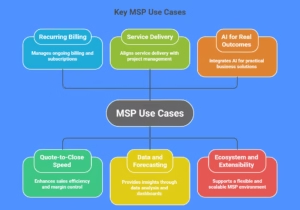
Below is how Dynamics 365 and HubSpot compare in real MSP environments — where renewals, quoting, and service delivery all tie directly to revenue.
1) Recurring Billing, Renewals, and CSP/Subscriptions
Dynamics 365 + Work 365: Handles automated subscription billing, provisioning, renewals, and license changes. Prevents “revenue leaks” by syncing billing and client contracts with your CRM.
HubSpot: Works well for reminders and renewal tracking but requires external billing tools for automation. Renewal visibility drops without deep integration into operations or PSA systems.
Verdict: Dynamics 365 wins for MSPs running Microsoft CSP, MRR, or complex billing cycles.
2) Quote-to-Close Speed and Margin Control
Dynamics 365 + Experlogix CPQ: Ideal for complex MSP quotes with multiple bundles, SKUs, and discount rules. Automates pricing accuracy and creates proposals with one click.
HubSpot CPQ: Fast for simple quotes and small deals but limited when you manage variable costs or service packages.
Verdict: Dynamics 365 provides stronger margin protection and faster enterprise-level quoting.
3) Service Delivery, Projects, and PSA Alignment
Dynamics 365 Customer Service + Project Operations (+ Business Central): Links tickets, SLAs, projects, and invoicing directly to sales. You see full visibility from opportunity to delivery to payment.
HubSpot: Strong in pre-sales and marketing, but post-sale workflows require integrations with PSA or ERP tools.
Verdict: Dynamics 365 leads for MSPs who want end-to-end control beyond the sales cycle.
4) Data, Dashboards, and Forecasting
Power BI + Power Platform on Dynamics data: Gives real-time dashboards for MRR, churn, CAC:LTV, and forecast accuracy. Designed for CFO-level visibility.
HubSpot: Easy to use for marketing and sales analytics. For deep financial or service metrics, you need separate BI or warehouse tools.
Verdict: Dynamics 365 wins for data-rich MSPs that need cross-department visibility.
5) AI for Real Outcomes
Microsoft Copilot (Sales, Service, Projects): Summarizes accounts, drafts follow-ups, predicts churn, and highlights upsell opportunities.
HubSpot AI: Supports content creation and sales emails but lacks advanced forecasting and service analytics.
Verdict: Dynamics 365 offers AI that impacts every stage of the MSP revenue cycle.
6) Ecosystem and Extensibility (MSP Reality)
Microsoft Stack: Includes M365, Azure, Power Apps, Power Automate, and partner apps like Work 365 and Experlogix. Built to scale with MSP workflows.
HubSpot: Has a large app marketplace and flexible integrations, but deep finance and service connections require custom work.
Verdict: Dynamics 365 provides a purpose-built ecosystem for long-term MSP growth.
Total Cost of Ownership (TCO) for MSPs
When comparing HubSpot and Dynamics 365, cost isn’t just about licenses. It’s about the hidden labor and revenue losses that come from manual work, missed renewals, or disconnected tools.
HubSpot has a lower upfront cost and faster setup. It’s ideal for smaller MSPs that need marketing automation and simple sales tracking. But as your business grows, manual quoting, billing, and renewal work start adding hidden costs — like time spent updating spreadsheets or fixing billing errors.
Dynamics 365 requires a deeper initial setup but pays off with operational savings. Automation tools like Work 365 and Experlogix CPQ eliminate repetitive billing and quoting work. Integrated dashboards in Power BI cut reporting time and improve decision-making accuracy.
Here’s how the math often plays out for MSPs:
| Cost Area | HubSpot | Dynamics 365 |
| Licensing | Lower at start | Moderate but scalable |
| Setup time | Fast | Longer, more configuration |
| Renewal automation | Manual or third-party | Native via Work 365 |
| Quoting | Basic | Advanced via CPQ |
| Reporting depth | Marketing and sales | Full business view |
| Long-term ROI | Strong for small MSPs | Higher for growing MSPs |
The breakeven point typically comes around 15 to 20 users or $3 million in annual recurring revenue. Beyond that, Dynamics 365’s automation and visibility deliver a higher return by reducing churn, errors, and manual labor.
Verdict:
- Choose HubSpot for early-stage simplicity and speed.
- Choose Dynamics 365 when your MSP needs to control every part of the revenue cycle and measure results in one view.
Adoption and Change Management
Technology alone doesn’t drive growth. The biggest reason MSP CRM projects fail isn’t the platform — it’s the rollout.
Your team needs clear playbooks, process ownership, and training. Without that, even the best CRM turns into another unused tool.
Empellor CRM takes a strategy-first approach to every implementation. We help MSPs build growth systems that people actually use by focusing on:
- Process clarity: Define how leads, quotes, and renewals flow through your business.
- Phased rollouts: Start with quick wins like pipeline hygiene or renewal automation before expanding to CPQ or forecasting.
- Enablement and incentives: Give every role a reason to use the system, from sales reps tracking commissions to service teams managing client health.
- KPI-based success: Tie adoption goals to measurable business outcomes like faster quote turnaround or lower churn.
When people understand why the system matters, adoption follows naturally. That’s how MSPs move from “installing a CRM” to running a true growth engine.
Decision Matrix — Pick the Right Stack by MSP Stage
Every MSP is at a different stage of growth. The right CRM choice depends on your size, maturity, and biggest bottleneck. Use this matrix to find your best fit.
| MSP Profile | Primary Pain | Best Fit | Why It Works |
| Under 15 people, early marketing focus | Need more leads and basic quoting | HubSpot | Quick setup, strong inbound and email automation for demand generation |
| 15–75 people, stuck growth | Missed renewals, slow quotes, poor KPI visibility | Dynamics 365 + Work 365 + CPQ + Power BI | Connects sales, renewals, and finance for full revenue control |
| 50–200+ people, scaling | Multi-team coordination, BI, and finance tie-in | Dynamics 365 Suite | Ties projects, service, and finance into one view for accurate forecasting |
| Hybrid marketers | Love HubSpot marketing but need operational depth | HubSpot (Marketing) + Dynamics (Sales, Service, Finance) | Best of both worlds with clear system boundaries and synced data |
Takeaway:
- HubSpot wins when you need leads fast and want a simple marketing engine.
- Dynamics 365 wins when you’re scaling, managing renewals, or aligning multiple teams under one data model.
- Many MSPs find success with a hybrid model — HubSpot for top-of-funnel, Dynamics for everything revenue and retention.
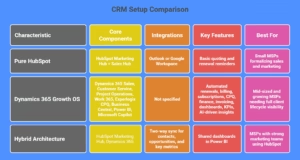
Reference Architectures (Diagrams You Can Show)
To make the decision easier, here’s how each CRM setup typically looks in a real MSP environment. These “reference architectures” show how data, automation, and reporting flow through the business.
1. Pure HubSpot (SMB, Marketing-Led MSP)
- HubSpot Marketing Hub + Sales Hub
- Optional integrations with Outlook or Google Workspace
- Basic quoting and renewal reminders inside HubSpot
- Reporting focused on leads, campaigns, and deals
Best for: Small MSPs starting to formalize sales and marketing but not yet managing complex billing or multi-team delivery.
2. Dynamics 365 Growth OS (Full Revenue System)
- Dynamics 365 Sales for pipeline and forecasting
- Dynamics 365 Customer Service and Project Operations for delivery
- Work 365 for automated renewals, billing, and subscriptions
- Experlogix CPQ for quoting and margin control
- Business Central for finance and invoicing
- Power BI for dashboards and KPIs
- Microsoft Copilot for AI-driven insights
Best for: Mid-sized and growing MSPs needing visibility across the entire client lifecycle — from lead to renewal to invoice.
3. Hybrid Architecture (HubSpot + Dynamics)
- HubSpot Marketing Hub for inbound campaigns and lead capture
- Dynamics 365 for sales, renewals, and project management
- Two-way sync for contacts, opportunities, and key metrics
- Shared dashboards in Power BI to unify marketing and revenue data
Best for: MSPs with strong marketing teams that want to keep HubSpot for campaigns while managing operations and growth through Dynamics 365.
Each setup can evolve as your MSP scales. Empellor CRM helps define the right starting point and migration path based on your goals, budget, and internal readiness.
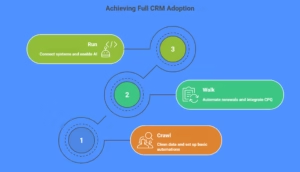
Migration Paths and Risk Mitigation
Switching systems or expanding your CRM can feel risky, but it doesn’t have to be. The key is to migrate in phases that build confidence and show quick wins.
Empellor CRM follows a crawl-walk-run approach to help MSPs modernize their tech stack without disrupting daily operations.
Crawl:
- Clean your pipeline and migrate contact data into the new CRM.
- Standardize lead stages, opportunity fields, and renewal tracking.
- Set up basic automations for follow-ups and reminders.
Walk:
- Automate renewals with Work 365 to stop revenue leaks.
- Add Experlogix CPQ for quoting consistency and margin control.
- Begin integrating Power BI dashboards for MRR, churn, and forecasts.
Run:
- Connect service delivery and finance systems to Dynamics 365.
- Enable Microsoft Copilot for AI insights and productivity boosts.
- Build predictive dashboards to model revenue growth and staffing needs.
Each phase should deliver measurable results before moving to the next. This keeps your team engaged and reduces resistance to change.
Empellor CRM’s phased rollouts help MSPs achieve full system adoption with less risk, smoother transitions, and visible ROI from day one.
FAQs
Q1: Can I keep HubSpot for marketing and move sales or renewals to Dynamics?
Yes. Many MSPs run a hybrid setup. Keep HubSpot for inbound marketing and automation, then use Dynamics 365 for sales, renewals, and service delivery. Just define data ownership and syncing rules between systems.
Q2: Do PSAs replace a CRM?
No. PSAs like ConnectWise and Autotask manage tickets and projects, not growth. A CRM handles leads, renewals, forecasting, and KPIs.
For best results, pair your PSA with a CRM so delivery and sales data flow together.
Q3: How does Copilot actually help an MSP?
Microsoft Copilot works inside Dynamics 365 to:
- Summarize client history and sales notes
- Draft follow-up emails and proposals
- Highlight churn risks or upsell opportunities
- Predict revenue trends using real data
It saves time and gives teams insights they can act on instantly.
Q4: What KPIs should we see in one pane of glass?
Every MSP should track:
- Monthly Recurring Revenue (MRR)
- Net Revenue Retention
- Churn Rate
- Pipeline Velocity
- Margin per Service Package
- Forecast Accuracy
You can visualize all of these in Power BI, connected directly to Dynamics 365 data.
Who Should Choose What?
Both HubSpot and Dynamics 365 are excellent platforms, but they serve different MSP needs. The right choice depends on where your business is in its growth journey and how deeply your operations are connected.
Choose HubSpot if:
- You’re in the early stages and need quick marketing momentum.
- Your team is small and focused on generating and tracking leads.
- You want an easy-to-launch CRM for sales and email automation.
Choose Dynamics 365 if:
- Your growth depends on managing renewals, quoting, and service delivery.
- You need visibility into revenue, projects, and financial data.
- You want to use AI, forecasting, and automation to scale profitably.
Many MSPs succeed with a hybrid approach — HubSpot for marketing and Dynamics 365 for everything post-sale. This keeps demand generation simple while giving your revenue operations the depth they need to scale.
Empellor CRM helps MSPs design the right system architecture, integrate both platforms if needed, and roll out adoption playbooks that make growth predictable.
Book your MSP Growth Assessment to find the best CRM stack for your business and build a rollout plan that drives measurable results.
Because CRMShouldntSuck — it should grow with you.