Skip to content

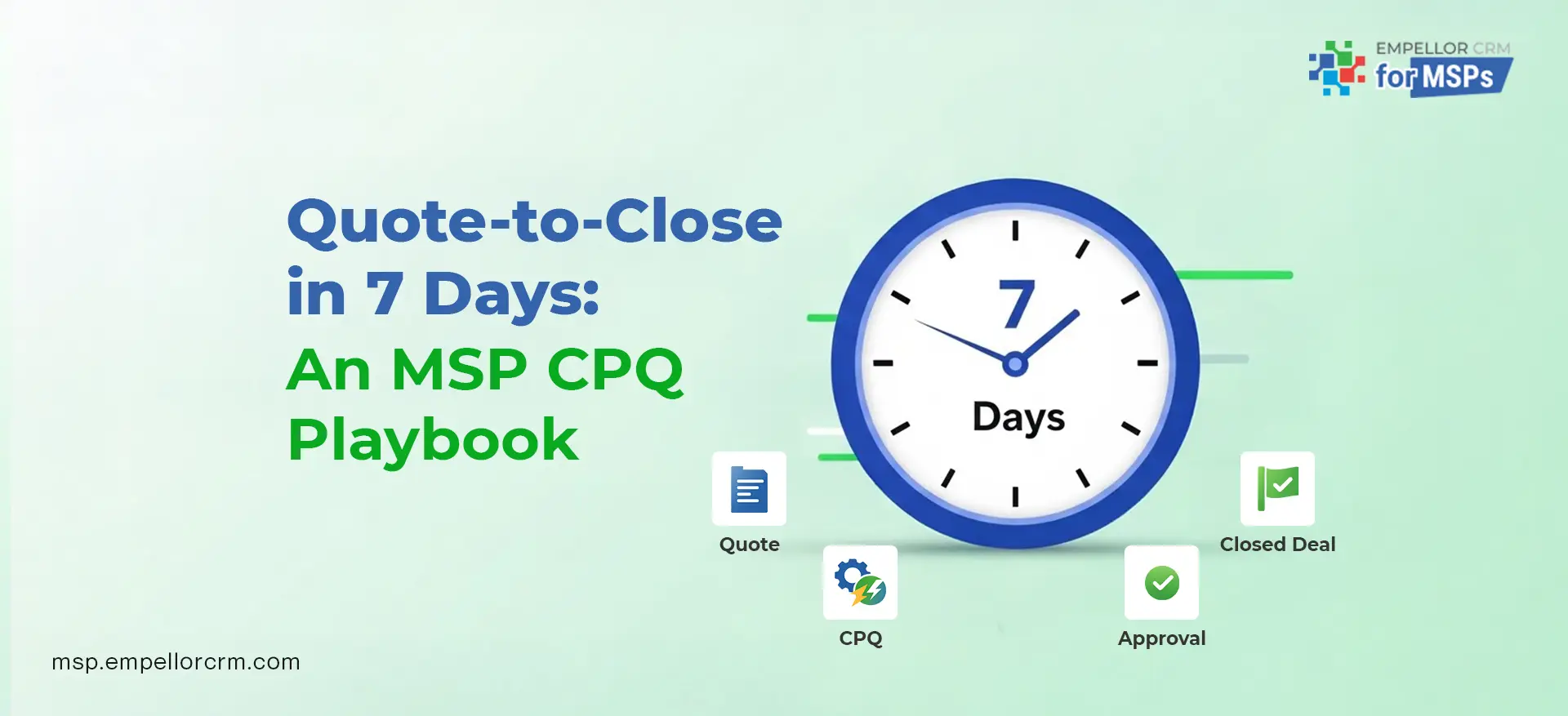
Quote-to-Close in 7 Days: An MSP CPQ Playbook
Most MSPs do not lose deals on capability.
They lose deals on time.
Quotes wait on approvals.
Proposals sit in inboxes.
“Send it over, and we’ll review,” turns into silence.
Every extra day adds risk.
The buyer loses urgency.
Stakeholders get pulled into other priorities.
The deal drifts into no decision.
This playbook shows how standard MSP packages can close in seven days.
Not by rushing.
By removing friction with CPQ structure, guardrails, live proposal reviews, and a clear Mutual Action Plan.
TL;DR
Goal: Proposal out in 48 hours or less. Signature in 7 days or less.
How: Pre-built bundles, CPQ guardrails, live proposal reviews, and a Mutual Action Plan.
Rule: If no live review is on the calendar, the proposal is not sent.
Snippet summary:
MSPs close standard deals in seven days when offers are pre-built, pricing is guarded, approvals are automated, and every proposal is reviewed live with a Mutual Action Plan.
The 7-Day Promise: When It Applies and When It Does Not
This motion is not for every deal.
It is for repeatable MSP offers with a clear scope.
When it applies
This works best when:
-
You sell standard recurring bundles
-
The prospect is SMB or mid-market
-
Legal and procurement are light
-
Stakeholders are reachable
-
The scope is stable
Typical stack:
Microsoft 365, endpoint security, backup, SOC, helpdesk, monitoring.
When it does not apply
Do not force seven days when:
-
The scope changes daily
-
The deal is an RFP
-
The prospect is locked into vendor requirements
-
The project is a custom integration-heavy
-
Legal review is complex by default
Prerequisites to run this playbook
Before you promise speed, confirm these are true:
-
ICP is defined
-
The pricing library is loaded in CPQ
-
Margin floors are set
-
Templates are approved
-
E-signature is connected
-
Payment collection is defined
-
Contracts and SOW language are standardized
Quick takeaway:
Speed is earned. It is not wished into existence.
CPQ Architecture That Makes 7 Days Possible
Seven-day deals come from engineering.
Not hustle.
Build CPQ like an assembly line.
Configure. Price. Approve. Send. Sign. Handoff.
Offer architecture
Your offers should be easy to choose.
Not hard to compare.
Use:
-
Good, Better, Best bundles by seat
-
Device and site add-ons
-
Clear scope boundaries per tier
-
Implementation and onboarding included as line items
Add vertical kits when it matters:
Healthcare, legal, and manufacturing.
Include compliance adders as options, not custom work.
Include phased rollouts:
Phase 1 essentials. Phase 2 hardening.
Pricing and margin guardrails
Guardrails protect speed and margin.
Set:
-
Seat and device matrices
-
Minimum MRR floor by bundle
-
Tiered term pricing for 12, 24, 36 months
-
Implementation fee logic based on seats and complexity
Add risk-based requirements when needed:
-
MFA required if identity risk flags exist
-
Backup required for servers
-
EDR is required for regulated industries
Approvals and governance
Standard deals should flow.
Only exceptions should stop.
Auto-approve within guardrails.
Route approvals only when:
-
Discount exceeds your threshold
-
The term is below 12 months
-
Margin drops below the floor
-
Non-standard clauses are requested
Track revisions with reason codes.
Revision count should be visible in the opportunity record.
Contracts and paper
Paper should not be a bottleneck.
Use:
-
Pre-approved MSA, DPA, and SOW snippets
-
Auto-merge customer name, term, SLA, start date
-
E-signature links inside the proposal pack
-
Deposit or first-month payment option, where the policy allows
Integrations you must have
CPQ cannot be isolated.
Minimum integrations:
-
CRM for pipeline and attribution
-
PSA for onboarding handoff
-
E-signature
-
Payments
-
Document storage
-
Tax engine if needed
-
Product catalog feeds if pricing changes often
Quick takeaway:
Fast quoting is built. It is not improvised.
The 7-Day Timeline (Owners, Artifacts, Exit Criteria)
Use this as a repeatable checklist.
Each day has an owner and an exit.
Day 0: Discovery and qualification (AE, 45 to 60 minutes)
Capture:
-
Pain and impact
-
Deadline and urgency
-
Seat and device counts
-
Security and compliance stakes
-
Incumbent risk and switching concerns
Before the call ends, book:
-
Day 2 validation call
-
Day 3 live proposal review
Exit criteria:
-
ICP fit scored
-
Decision path noted
-
MAP started with stakeholders and target dates
Day 1: Configure and price in CPQ (AE or SE, 60 to 90 minutes)
Build Good, Better, Best options.
Attach onboarding plan and assumptions.
Run margin guardrails.
Stage approvals if needed.
Exit criteria:
-
Draft quote ready
-
Draft SOW ready
-
One-page value recap ready
Day 2: Validation call (AE + SE + champion, 30 to 45 minutes)
Confirm scope, success criteria, and term.
Preview commercials verbally.
Do not send a PDF yet.
Surface security and legal early.
Finalize MAP due dates and owners.
Exit criteria:
-
Proposal content frozen
-
Internal approvals triggered
-
MAP updated with real dates
Day 2 afternoon: Finalize, approve, stage (RevOps, 30 to 60 minutes)
Generate a proposal pack from CPQ.
Route approvals automatically.
Insert e-sign and payment links.
Send the calendar invite for Day 3 review.
Exit criteria:
-
Live proposal review scheduled
-
Proposal ready to present on screen
Day 3: Live proposal review (AE, 30 to 45 minutes)
Share screen. Walk the buyer through:
Decision criteria. Scope. Economics. Timeline. Onboarding.
Handle objections live.
Confirm the signature path and who signs.
Confirm timing.
Exit criteria:
-
Signature occurs same call or
-
Legal review call scheduled within 48 hours
Day 4 to 5: Objections, redlines, executive confirm (AE + legal as needed)
Send a short CFO pack.
Keep it numbers-first.
Allow one revision round maximum.
Regenerate documents in CPQ with tracked changes.
Exit criteria:
-
Final approval confirmed
-
Signature meeting booked
Day 6: Sign and collect (AE + buyer)
Execute e-signature.
Collect the deposit or the first month if used.
Confirm kickoff details.
Exit criteria:
-
Closed-won
-
Kickoff invite sent
Day 7: Handoff and kickoff (CS + PSA owner)
Auto-create onboarding project in PSA.
Assign roles and dates.
Share 30, 60, 90 plan.
Propose the first QBR date.
Exit criteria:
-
Customer created in PSA
-
Billing set
-
Onboarding plan shared
Quick takeaway:
Seven days work when every day has a deliverable.
Live-Speed Plays That Collapse Cycle Time
These are the habits that prevent drift.
Proposal in 48 hours
Templates and guardrails remove waiting.
Target 90 percent or higher for standard deals.
Always-be-scheduling
No call ends without a date.
If the next meeting is not booked, the deal slows.
Two-thread minimum
Engage a champion and an economic buyer by Day 3.
Single-threaded deals stall later.
No proposal by email
Proposals die in inboxes.
Review live. Send the PDF after the call.
MAP on page one
Present the plan to the buyer.
Owners. Due dates. Evidence. Risks.
Quick takeaway:
Speed comes from scheduled steps, not follow-ups.
Templates and Artifacts Your Playbook Ships With
You cannot run this with custom work every time.
Ship with templates.
Include:
-
MAP table (workstream, owner, due date, evidence, risk)
-
Discovery sheet (pain, impact, deadline, seats, compliance, incumbent)
-
Good, Better, Best quote template with scope boundaries
-
Onboarding timeline and assumptions page
-
CFO pack (ROI, TCO, cost of delay, term options)
-
Security packet (responsibilities, posture summary, IR outline)
-
Redline rules (negotiable vs anchored)
Common MSP Roadblocks and Your CPQ Fixes
Too many options
Fix it with Good, Better, Best.
Tie each tier to a clear outcome.
Margin erosion
Fix it with floor pricing and discount fences.
Route exceptions automatically.
Legal slows everything down
Fix it with pre-approved clauses.
Escalate only on exceptions.
Scope creep
Fix it with line-level assumptions.
Add an out-of-scope section.
“Send it over, we’ll review.”
Fix it with policy.
No live review means no proposal.
Metrics to Run This Like an Assembly Line
Track speed, quality, and profit.
Speed:
-
Quote-to-close time (target 7 days or less)
-
Proposal in 48 hours rate (target 90 percent or more)
-
Approval turnaround time (median hours)
Quality:
-
Live review rate (target 100 percent)
-
Revision count (target 1 or less)
-
MAP adoption rate
-
Economic buyer access rate
-
No decision rate by source and vertical
Profit:
-
Margin versus floor
-
Discount compliance
-
Term mix (12, 24, 36-month distribution)
Forecast:
-
Commit accuracy when MAP evidence is present
Governance and Cadence
Speed needs discipline.
Weekly deal factory
Review top deals by value and stage age.
Advance. Redesign. Or remove.
Monthly quote QA
Audit a sample of proposals.
Check scope clarity and guardrail compliance.
Quarterly win-loss review
Update bundles, pricing rules, and redline standards.
Use real reasons, not assumptions.
FAQ (snippet-ready)
Can every deal close in seven days?
No. Use this for standard stacks with a stable scope. Route bespoke deals to a longer path.
What is the number one accelerator?
Booking the live proposal review during validation. Not after.
How do we keep margin while moving fast?
Use margin floors, discount fences, and automated approvals in CPQ.
What if legal slows us down?
Use pre-approved contracts and exception lanes. Put legal steps in the MAP with due dates.