Skip to content

Every MSP wants more leads — but not every lead turns into revenue. Too often, teams chase vanity metrics like clicks and downloads while the real growth levers hide in plain sight: which sources actually close deals at speed and profit.
Lead quantity looks great in a dashboard, but lead quality and conversion determine whether your pipeline is healthy. The smartest MSPs don’t ask “what gets us the most leads?” They ask, “What turns into revenue?”
Empellor CRM’s MSP Revenue Flywheel research shows that referrals and local intent search lead in conversion efficiency, while co-sell, webinars, and partnerships shine in longer-term deal value. The difference between success and wasted spend often comes down to one thing — whether you’re measuring closing power, not impressions.
Quick Takeaway: Fund What Closes, Not What Clicks
Stop guessing which channels “work.” Grade every lead source by this simple rule:
Close Rate × Average Deal Value × Win Velocity ÷ Customer Acquisition Cost (CAC).
Once your CRM tracks this data consistently, you can see which sources create predictable revenue — and which burn time and money.
Standardize source tracking, stage conversion, and SLAs in Dynamics 365. Review each channel quarterly in your QGR, and reallocate budget based on closing performance, not activity metrics.
Don’t ask “what gets the most leads?” Ask “what closes the fastest at the best margin.” Measure every source by Close Rate × ACV × Win Velocity ÷ CAC, and double down on what wins.
The Only Formula That Matters
The goal of marketing isn’t to generate leads — it’s to generate revenue you can trust. That means grading each lead source not by clicks or form fills, but by its ability to produce profitable, fast-closing deals.
Use this simple equation to score every channel:
Closing Power Score = (Close Rate × Average Deal Value × Win Velocity) ÷ CAC
How It Works
- Close Rate – The percentage of opportunities that become wins.
- Average Deal Value (ACV) – How much revenue each deal produces.
- Win Velocity – How fast deals close (shorter cycles = higher score).
- Customer Acquisition Cost (CAC) – Total cost to win the client.
This formula helps you compare apples to apples — a paid search lead that costs more but closes faster might outrank a “cheap” referral if it scales consistently.
Why MSPs Get False Positives
Most MSPs think a channel is working when it really isn’t because of:
- Referral bias – High conversion but low volume, hiding pipeline gaps.
- Dirty UTM data – Campaigns tagged inconsistently or overwritten by retargeting.
- PSA ≠ CRM – Service tools track tickets, not pipeline; real attribution lives in CRM.
Without clean data, your budget decisions are guesswork.
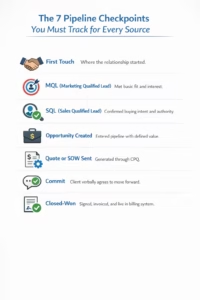
The 7 Pipeline Checkpoints You Must Track for Every Source
- First Touch – Where the relationship started.
- MQL (Marketing Qualified Lead) – Met basic fit and interest
- SQL (Sales Qualified Lead) – Confirmed buying intent and authority.
- Opportunity Created – Entered pipeline with defined value.
- Quote or SOW Sent – Generated through CPQ.
- Commit – Client verbally agrees to move forward.
- Closed-Won – Signed, invoiced, and live in billing system.
These stages are the backbone of accurate revenue attribution in Dynamics 365 — without them, you can’t compare channels or forecast growth.
Quick Takeaway:
The best lead source isn’t the one that fills your inbox — it’s the one that turns pipeline into cash, quickly and profitably. Grade channels by Closing Power, not popularity.
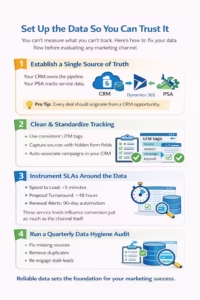
Set Up the Data So You Can Trust It
You can’t improve what you can’t measure — and most MSPs don’t have clean enough data to tell which sources actually close. Before you judge any marketing channel, fix your data flow.
Step 1: Establish a Single Source of Truth
Your CRM owns the pipeline.
Your PSA owns delivery.
Stop mixing the two. PSAs track service data, not sales attribution. All opportunities, quotes, and deal values should live in Dynamics 365, with your PSA feeding post-sale insights like margin or SLA performance.
Pro Tip: Every closed deal should originate from a CRM opportunity with a linked campaign source. No exceptions.
Step 2: Clean and Standardize Tracking
- Create consistent UTM conventions for every campaign (source, medium, content, keyword).
- Use hidden fields on forms and landing pages to auto-capture lead source data.
- Enable auto-association of campaigns to opportunities in Dynamics 365, ensuring first-touch and last-touch are recorded accurately.
This prevents “unknown source” and “direct traffic” from eating half your reports.
Step 3: Instrument SLAs Around the Data
Measure not just where leads come from, but how well your team responds. Track:
- Speed to Lead: Target <5 minutes.
- Proposal Turnaround: <48 hours using Experlogix CPQ.
- Renewal Alerts: 90-day automation in Work 365.
These service levels influence conversion just as much as the channel itself.
Step 4: Run a Quarterly Data Hygiene Audit
Each quarter, review your CRM for:
- Unassigned opportunities
- Missing or incorrect sources
- Inactive workflows
- Duplicates between PSA and CRM
If it’s not in the system, it didn’t happen — and it shouldn’t get budget. No data, no budget. If a channel can’t prove its results through CRM reporting, it doesn’t deserve next quarter’s spend.
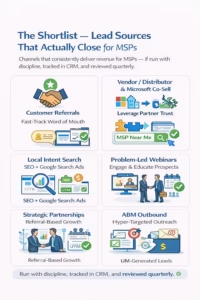
The Shortlist — Lead Sources That Actually Close for MSPs
Not all leads are equal. Some channels generate attention; others generate revenue. These are the lead sources that consistently close for MSPs — when they’re run with discipline, tracked in CRM, and reviewed quarterly.
Each one below includes where it wins, where it struggles, how to run it, and what to measure.
1. Customer Referrals (Bonus Channel, Not a Plan)
Where It Wins: Highest trust, shortest sales cycle, highest close rate.
Where It Loses: Unpredictable and concentrated — no scalability.
How to Run:
- Ask for referrals after QBRs or major wins.
- Route to a fast-track sequence with 24-hour follow-up.
- Offer reference calls to accelerate trust.
What to Measure:
- Referral share of total revenue.
- Time-to-close vs. non-referral deals.
- Gross margin retention.
Tip: Track referrals separately in CRM as “Bonus Channel,” not “Marketing Source.”
2. Vendor / Distributor & Microsoft Co-Sell / Marketplace
Where It Wins: Leverages existing trust and pre-qualified demand.
Where It Loses: Can be slow-moving due to partner approval and queue time.
How to Run:
- Develop enablement assets and co-branded case studies.
- Host joint webinars or marketplace campaigns.
- Assign a partner manager to nurture relationships.
What to Measure:
- Sourced vs. influenced revenue.
- Win rate and cycle time vs. direct deals.
- Partner-sourced pipeline velocity.
Insight: Co-sell deals often have ACVs 20–25% higher but require stronger forecasting discipline.
3. Local Intent Search (SEO + Google Search Ads)
Where It Wins: High-intent buyers already seeking MSP services in your area.
Where It Loses: Attracts low-quality traffic if targeting is too broad.
How to Run:
- Optimize for city and industry keywords (“MSP for healthcare in Austin”).
- Use comparison pages and call routing within 5 minutes.
- Apply negative keyword filters to avoid generic traffic.
What to Measure:
- Qualified form and call rate.
- Opportunities per keyword theme.
- Cost per qualified opportunity (CPO).
Pro Tip: In Dynamics 365, connect ad platform UTMs directly to opportunity records for true ROI tracking.
4. Problem-Led Webinars & Workshops
Where It Wins: Builds credibility and trust with decision-makers; great for multi-stakeholder deals.
Where It Loses: Poor follow-up destroys ROI.
How to Run:
- Promote vertical-specific topics like “Cybersecurity Readiness” or “AI in Managed Services.”
- Embed a calendar link on the thank-you page.
- Send a 7-day proof sequence after attendance, with a recap and CTA.
What to Measure:
- Registrant → Attendee rate.
- Attendee → SQL → Quote rate.
- Cost per opportunity created.
Power Move: Auto-tag webinar attendees in CRM and assign follow-up SLAs using Power Automate.
5. Strategic Partnerships (Accounting Firms, VCs, Industry Groups)
Where It Wins: Consistent flow of ideal prospects via trusted partners.
Where It Loses: Breaks down if there’s no clear value exchange.
How to Run:
- Build co-marketing kits and joint offers.
- Set quarterly target reviews and shared CRM fields for attribution.
- Reward partners with visibility or referral bonuses.
What to Measure:
- Partner-source velocity.
- Win rate vs. direct channels.
- Lifetime value (LTV) per partner.
Tip: Include partner activity metrics in your QGR to sustain accountability.
6. ABM Outbound (Account-Based Marketing)
Where It Wins: Highly targeted; great for specific verticals or larger accounts.
Where It Loses: Wasteful if lists are too broad or unverified.
How to Run:
- Build triggers: compliance changes, hiring trends, or security incidents.
- Run multichannel sequences (email, LinkedIn, mailers).
- Personalize first outreach around pain, not product.
What to Measure:
- Account engagement.
- Meetings per 100 targeted accounts.
- Opportunities created per SDR hour.
Bonus: ABM paired with nurture automation increases win rates by 25% (Empellor CRM data).
7. Review Sites & Third-Party Directories (G2, Clutch, MSP Listings)
Where It Wins: Attracts late-stage buyers.
Where It Loses: Can become “pay-to-play” without verified proof.
How to Run:
- Capture reviews after every QBR or major renewal.
- Keep your listings updated and keyword-optimized.
- Create “Compare Us” pages linking back to your profiles.
What to Measure:
- Opportunity rate from profile views.
- Win rate vs. organic site leads.
- ROI of listing fees.
Insight: Prospects visiting comparison sites convert 1.6× faster than generic organic traffic.
8. Live Events & Community Engagement
Where It Wins: Builds strong trust and owner-to-owner relationships.
Where It Loses: Low ROI without quick follow-up.
How to Run:
- Use QR codes for instant event booking.
- Send a recap email within 24 hours and proof assets within 10 days.
- Track everything in CRM under “Event Source.”
What to Measure:
- On-site meetings booked.
- Opportunities per event.
- Total CAC including travel/time cost.
Your top sources aren’t random — they’re measurable. Focus your MSP’s time and budget on the channels that close deals at speed, with high margins, and at scale.
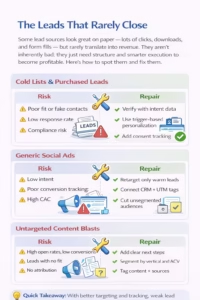
The Leads That Rarely Close
Some lead sources look great on paper — lots of clicks, downloads, and form fills — but rarely translate into revenue. They aren’t inherently bad; they just need structure and smarter execution to become profitable.
Here’s how to spot them and what to fix.
1. Cold Lists and “Purchased Leads.”
Problem: Dirty data, low intent, and minimal personalization lead to low engagement and spam complaints.
Fix:
- Use verified triggers (compliance updates, new funding, job postings).
- Warm contacts through LinkedIn or industry introductions before outreach.
- Connect CRM enrichment tools to keep data up to date.
| Risk | Repair |
| Poor fit or fake contacts | Verify with intent data or firmographics |
| Low response rate | Use trigger-based personalization |
| Compliance risk | Add consent tracking and opt-in workflows |
2. Generic Social Ads
Problem: Awareness campaigns drive attention, not action. Broad targeting floods the CRM with unqualified leads.
Fix:
- Run retargeting ads for existing visitors and known prospects.
- Offer specific, high-value assets (ROI calculators, pricing guides).
- Sync lead ads directly to CRM workflows for immediate follow-up.
| Risk | Repair |
| Low intent | Retarget only warm audiences |
| Poor conversion tracking | Connect CRM + UTM tracking |
| High CAC | Cut unsegmented audiences and test copy by ICP |
3. Untargeted Content Blasts
Problem: Overly broad content generates MQLs that never reach SQL or Opportunity stages.
Fix:
- Narrow topics to vertical-specific pain points and outcomes.
- Use comparison guides instead of generic blogs.
- Map every asset to a CRM stage and track engagement by funnel depth.
| Risk | Repair |
| High open rates, low conversions | Add clear next steps in every piece |
| Leads with no fit | Segment by vertical and ACV |
| No attribution clarity | Tag all content with campaign and source fields |
“Low-closing” sources aren’t failures — they’re systems waiting for refinement. When tracked correctly and tied to CRM workflows, even weak channels can become steady performers.
Scorecard Template — How to Decide Budget Next Quarter
Quarterly budget planning shouldn’t be based on gut feeling or marketing opinions. Your CRM already holds the truth — you just need to read it correctly.
This Lead Source Scorecard lets you compare every channel side by side to decide what to kill, fix, or double down on next quarter.
Lead Source Scorecard Template
| Source | MQL → SQL % | SQL → Opp % | Opp → Win % | Avg ACV | Sales Cycle (Days) | CAC | Closing Power Score | Next-Quarter Action |
| Referrals | 75% | 60% | 55% | $45K | 21 | $500 | 5.9 | Maintain – high conversion, low CAC |
| Local Intent Search | 40% | 45% | 30% | $35K | 40 | $1,200 | 3.9 | Increase budget – scalable and profitable |
| Partner / Co-Sell | 50% | 50% | 25% | $60K | 55 | $2,000 | 3.7 | Optimize follow-up – improve velocity |
| Webinars / Workshops | 30% | 35% | 20% | $50K | 60 | $1,500 | 2.3 | Continue – nurture-driven pipeline |
| Paid Social | 25% | 15% | 10% | $25K | 70 | $1,800 | 0.8 | Cut budget – high CAC, long cycle |
How to Use the Scorecard
- Pull conversion data from Dynamics 365 (stages: MQL → SQL → Opportunity → Win).
- Update ACV, cycle length, and CAC from Power BI dashboards each quarter.
- Calculate the Closing Power Score using:
(Close Rate × ACV × Win Velocity) ÷ CAC. - Color code metrics:
- Green: Performing at or above benchmark.
- Yellow: Needs optimization.
- Red: Underperforming; review or replace.
- Green: Performing at or above benchmark.
Budget Decision Rules
- Promote: Channels with 2+ green metrics.
- Fix: Channels with 1 green and 1 yellow.
- Kill: Any channel with consistent red performance for 2+ quarters.
Grade lead sources like investments — fund the ones that compound, cut the ones that burn capital.
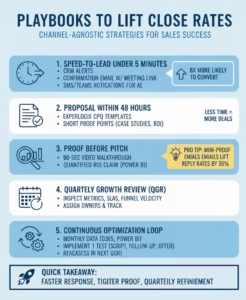
Playbooks to Lift Close Rates (Channel-Agnostic)
No matter where your leads come from, how you handle them determines whether they close. These playbooks apply to every channel and directly raise your win rate without increasing ad spend.
1. Speed-to-Lead Under 5 Minutes
Response time is the single biggest factor in conversion. Leads contacted within five minutes are 8× more likely to convert than those reached after an hour.
- Set CRM alerts and automate lead routing through Dynamics 365.
- Send an immediate confirmation email with a meeting link.
- Add SMS or Teams notifications for instant AE response.
2. Proposal Within 48 Hours
Every extra day between the demo and the proposal reduces your close rate.
- Use Experlogix CPQ templates to generate quotes and SOWs instantly.
- Enforce a “proposal in 48 hours” SLA, automatically tracked in the CRM.
- Include short proof points (case studies, ROI tables) with every quote.
3. Proof Before Pitch
Instead of repeating features, send “mini-proof” messages that remind prospects of results.
- Bullet-point recap of discovery call takeaways.
- 90-second video clip or walkthrough addressing their exact challenge.
- Quantified ROI claim based on past clients (tracked in Power BI).
Mini-proof emails lift follow-up reply rates by 35%.
4. Quarterly Growth Review (QGR)
Once per quarter, pick one friction to eliminate from your sales process — missed follow-ups, slow quotes, weak renewals — and build a system fix.
- Use QGRs to inspect source-level metrics, SLAs, and funnel velocity.
- Assign owners for each improvement and track progress.
5. Continuous Optimization Loop
- Pull data from Dynamics 365 and Power BI monthly.
- Identify one underperforming metric (conversion, cycle time, CAC).
- Implement one test (script update, faster follow-up, revised offer).
- Reassess results in the next QGR.
You don’t need more leads to close more deals — you need faster response, tighter proof, and quarterly refinement.
FAQs
Q1: What’s the best lead source for small MSPs?
Usually, it’s a combination of local intent search and referrals.
Referrals close faster but aren’t predictable. Local SEO and paid search bring steady, in-market demand. Validate both by tracking conversion stages in your CRM scorecard — if they move from MQL → SQL → Win, they’re worth funding.
Q2: How do I avoid “MQL theater”?
Stop grading campaigns on clicks or form fills.
Fund channels based on SQL and Opportunity creation, not lead volume. Calculate each source’s Closing Power Score (Close Rate × ACV × Win Velocity ÷ CAC), and drop anything that doesn’t convert to qualified opportunities.
Q3: How often should I adjust budgets by source?
Reassess quarterly during your QGR.
Follow a “kill, fix, or fund” rule:
- Kill underperformers with 2+ red metrics.
- Fix yellow sources with a clear bottleneck.
- Fund green performers that compound growth over time.
Q4: Which KPIs matter most for source optimization?
- Win Rate – True indicator of source quality.
- Average Contract Value (ACV) – Shows long-term revenue potential.
- Sales Cycle Length – Reveals efficiency by channel.
- Customer Acquisition Cost (CAC) – Determines scalability.
- Net Revenue Retention (NRR) – Tracks expansion potential.
Quick Takeaway:
The best lead source isn’t universal — it’s measurable. Track your data, grade your sources, and let results — not opinions — decide your spend.
Fund What Closes, Not What Clicks
The difference between MSPs that grow predictably and those that spin their wheels isn’t luck — it’s measurement. When you track the real numbers, you’ll see that most “lead problems” are actually data and follow-up problems.
Your best lead source is the one that:
- Wins deals at speed and healthy margin.
- Scales beyond word-of-mouth.
- Fits your Ideal Customer Profile (ICP) and renews consistently.
That means focusing on the channels that deliver measurable results—not vanity metrics.
- Standardize your data in Dynamics 365.
- Automate renewals and quoting through Work 365 and Experlogix CPQ.
- Use Power BI to visualize CAC, conversion, and cycle time.
- Run Quarterly Growth Reviews (QGRs) to re-score every source.
When you reallocate budget based on what closes, not what clicks, you stop chasing leads and start scaling revenue with intention.
Book your MSP Growth Assessment with Empellor CRM to build your lead source scorecard and optimize your pipeline for profit.
Because CRMShouldntSuck — it should show you exactly what’s working.