Skip to content

Referrals feel like free growth until they stop coming. Most MSPs start strong with word-of-mouth deals, then hit a plateau around $2 to $5 million in annual recurring revenue. That’s when the referral well runs dry, and the pipeline turns unpredictable.
The problem isn’t your service quality; it’s your system. Referrals depend on luck and timing, not process or visibility in your sales funnel for potential clients. You can’t forecast them, scale them, or hold anyone accountable for them.
To grow past the plateau, MSPs need a demand generation system that turns awareness into pipeline and pipeline into revenue.
Empellor CRM’s MSP Revenue Flywheel research shows that MSPs with structured demand-gen systems grow 40 percent faster than those that rely mainly on referrals. The difference is control: a predictable, data-driven engine that fuels every stage of growth in your B2B marketing efforts.
Quick Takeaway: The MSP Demand Gen Advantage
Referrals are unpredictable and unscalable.
MSPs that outgrow the plateau build a demand generation engine tied to CRM stages, renewals, quoting, delivery, and finance.
The winning move: a unified revenue engine powered by Dynamics 365, Experlogix CPQ, Work 365, Power BI, and Copilot — turning attention into pipeline, pipeline into revenue, and customers into expansion, on schedule.
Referrals are a bonus channel, not a growth strategy. A proper demand gen system connects marketing, sales, and renewals into a single CRM-driven revenue engine.
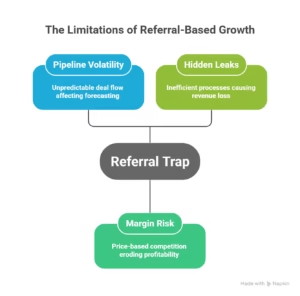
The Referral Trap — Why “Word of Mouth” Stalls at Around $2–5M ARR
Referrals help most MSPs get off the ground, but they also trap them there. Once you reach a few million in recurring revenue, word of mouth alone can’t feed the pipeline fast enough to sustain growth.
Here’s why referrals stop working as a long-term strategy
1. Pipeline Volatility
You have no control over who, when, or how many opportunities appear. Some months are packed with inbound deals; others are silent. This unpredictability makes forecasting impossible and strains cash flow planning.
2. Margin Risk
When every MSP promises “great service,” prospects can’t tell the difference. They start comparing prices instead of outcomes, forcing you to discount to win business.
Empellor CRM’s data shows that commoditization is the top reason MSP margins erode beyond the $2–5M mark.
3. Hidden Leaks
Manual renewals, spreadsheet follow-ups, and PSA “CRM” gaps quietly drain revenue. Deals go cold, renewals slip, and expansion opportunities disappear because there’s no consistent process to capture them.
Quick Takeaway:
Referrals are not a growth strategy; they’re a bonus channel. Once you rely on them as your primary pipeline source, your MSP’s growth becomes unpredictable and limited.
What Demand Gen Means for MSPs (Not Just “More Leads”)
Demand generation isn’t about flooding your inbox with random leads. It’s about building a repeatable system that creates, captures, and converts demand throughout the customer lifecycle—from first touch to renewal.
For MSPs, that means connecting every stage of the revenue journey:
- CRM for pipeline visibility and follow-up automation
- Work 365 for recurring billing and renewal management
- Experlogix CPQ for fast, accurate quoting in the sales funnel to secure high-quality leads.
- Power BI for reporting and forecasting
- Copilot for AI insights that speed decision-making
When these systems talk to each other, you stop guessing where revenue comes from and start engineering it.
MSP demand generation is a connected system that drives awareness, pipeline, and renewals by aligning marketing, sales, service, and finance around shared CRM data.
Example:
A cybersecurity-focused MSP might launch an “AI Readiness Audit” campaign to attract new leads through cold calling. Every form submission triggers:
- A lead record in Dynamics 365
- A quote workflow in Experlogix CPQ
- A renewal tracking task in Work 365
- And live KPI visibility in Power BI.
That’s demand generation in action — every step measurable, repeatable, and scalable.
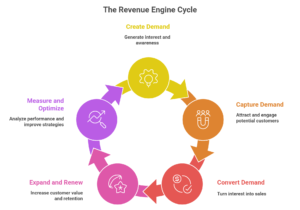
The Revenue Engine Architecture & How Growth Actually Compounds
Demand generation only works when every part of your MSP’s revenue process is connected. Think of it as a flywheel, not a funnel — where each stage fuels the subsequent and compounds growth over time.
Here’s how the five key stages work together inside a unified system like Dynamics 365 + Work 365 + Experlogix CPQ + Power BI + Copilot.
1) Create Demand
Start by defining your Ideal Customer Profile (ICP) and building campaigns around their biggest business pains.
- Focus on verticals like healthcare, construction, or professional services.
- Publish thought leadership content, run webinars, and co-market with vendors or partners.
These channels compound over time, creating awareness that keeps your brand top of mind.
2) Capture Demand
When buyers start looking, make it easy for them to engage.
- Use assets like comparison guides, ROI calculators, or readiness assessments.
- Capture and score leads inside your CRM to streamline your content marketing initiatives. Dynamics 365 Customer Insights to route them instantly.
Automated workflows ensure no opportunity slips through the cracks.
3) Convert Demand
Turn opportunities into revenue quickly and profitably.
- Use Experlogix CPQ to generate quotes in minutes, not days.
- Enforce a proposal turnaround SLA of under 48 hours.
- Standardize sales stages in Dynamics 365 with guided workflows and forecasts.
You’ll close faster, with fewer pricing errors and higher win rates.
4) Expand and Renew
Keep revenue growing after the sale.
- Work 365 automates renewals, billing, and upsell triggers.
- Set up 90-day renewal radars and QBR/QVR cadences to enhance your MSP lead generation efforts.
- Track client health with Power BI dashboards to identify expansion opportunities early in your content marketing strategy.
This step shows how MSPs turn customers into recurring profit centers through effective lead-generation strategies.
5) Measure and Optimize
You can’t scale what you can’t see.
- Use Power BI to monitor MRR, NRR, churn, and pipeline velocity.
- Let Copilot summarize account insights, flag churn risks, and suggest the following actions.
- Continuous optimization keeps your flywheel spinning faster every quarter.
Demand generation becomes unstoppable when it’s connected end-to-end from marketing through renewals using your CRM as the single source of truth.
Mini-Model to Beat the Referral Plateau
Demand generation isn’t magic, it’s math. Once you know your numbers, you can predict how much pipeline you need to hit your revenue targets.
Let’s say your goal is to add $1 million in new Annual Recurring Revenue (ARR) over the next 12 months. Here’s how to break it down for better MSP lead generation.
| Stage | Conversion Rate | Required Volume of leads for practical B2B marketing efforts. | Example Notes |
| Leads to MQL (Marketing Qualified Lead) | 10% | 2,000 leads → 200 MQLs | From webinars, content, paid ads, and referrals |
| MQL to SQL (Sales Qualified Lead) | 50% | 200 → 100 SQLs | Leads that match ICP and have intent |
| SQL to Opportunity | 60% | 100 → 60 opportunities | Qualified and budget-approved prospects |
| Opportunity to Win | 33% | 60 → 20 wins | Using CPQ and sales playbooks |
| Average Contract Value (ACV) | — | $50,000 | Typical managed services contract |
✅ Result: 20 wins × $50,000 = $1 million ARR
How to Use This Model
- Plug in your real conversion rates and deal values.
- Track every stage in Dynamics 365 using guided sales workflows.
- Use Power BI to visualize your pipeline coverage ratio (3–4× your revenue target) and implement effective lead-generation strategies.
- Remember the lag effect, start your demand generation efforts 90 to 120 days before you want pipeline results.
Growth becomes predictable when you know your funnel math and can see conversion rates inside your CRM.
Channels That Work for MSP Demand Gen
Not all marketing channels work the same for MSPs. The key is orchestration, combining education, credibility, and automation so your campaigns feed directly into your CRM and sales system.
Here’s how to build a mix that actually produces pipeline, not just clicks.
Core Channels (Always-On Growth Drivers)
- Educational Content: Publish guides, checklists, and comparison pages that speak to real MSP buyer pains — compliance, cybersecurity, AI readiness, or cost control.
- Webinars and Virtual Events: Partner with vendors or run workshops tied to service outcomes. Use Dynamics 365 forms to auto-create leads and score engagement for your outbound marketing efforts.
- Customer Stories: Turn case studies into short videos or articles that show ROI. Use them in nurture sequences and sales decks.
- SEO + Blog Strategy: Target industry-specific topics that feed your funnel long-term, like “MSP automation best practices” or “Microsoft Copilot for IT services.”
Assist Channels (Amplifiers for Reach and Conversion)
- Paid Search: Capture intent from prospects already looking for solutions.
- Paid Social: Run educational campaigns on LinkedIn to reach decision-makers within your target verticals.
- Partner Co-Marketing: Team up with complementary vendors to share leads and expand audience reach.
- Events and Community: Sponsor or host local IT roundtables with clear follow-up automation built into your CRM.
Non-Negotiables for Every Channel
- Dedicated Offers: Every campaign needs a clear next step, an assessment, a pricing guide, or an ROI calculator.
- Retargeting is a crucial component of MSP lead generation that addresses potential customer pain points. Use ads to stay visible to site visitors who didn’t convert the first time.
- Email Journeys: A vital part of your marketing strategies to nurture MSP leads. Nurture prospects automatically between stages using Dynamics 365 workflows to optimize your sales funnel.
- CRM Attribution: Track every lead source and tie it to outcomes in Power BI.
Quick Takeaway:
Channels only work when they’re connected. Every MSP campaign should start with an offer, pass data into CRM, and loop back into reporting for optimization.
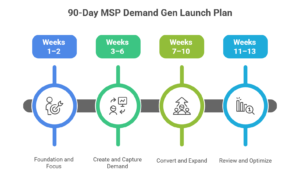
The MSP Demand Gen Playbook (90-Day Launch Plan)
You don’t need a massive marketing department to build demand gen; you need a 90-day plan that’s focused, measurable, and connected to your CRM.
Here’s how to launch your first demand engine in three clear phases.
Weeks 1–2: Foundation and Focus
- Finalize your Ideal Customer Profile (ICP) and key positioning.
- Map customer pains to offers like “Cyber Readiness Assessment” or “AI Audit.”
- Set funnel targets, SLAs, and team responsibilities.
- Build your MSP market presence with targeted marketing strategies. Power BI baseline dashboard: Use pipeline hygiene metrics to ensure a healthy flow of MSP leads in your marketing efforts.
Goal: clarity on who you’re targeting, what you’re offering, and how success is measured.
Weeks 3–6: Create and Capture Demand
- Launch at least two gated offers (e.g., Cybersecurity Scorecard or AI Readiness for MSP Clients).
- Running a Webinar series can be a highly effective lead generation strategy for managed service providers. And sync registrations to Dynamics 365 for automatic source → stage attribution.
- Configure lead scoring and follow-up sequences in your CRM.
- Implement proposal SLAs in Experlogix CPQ to ensure quotes are issued within 48 hours.
Goal: generate and qualify early opportunities.
Weeks 7–10: Convert and Expand
- Add paid search campaigns for high-intent keywords and industries.
- Launch partner co-marketing programs with vendors or software providers.
- Use Work 365 to trigger renewal and upsell campaigns for clients in a 90-day window.
- Track all KPIs in Power BI dashboards to see what’s working.
Goal: prove pipeline lift and start converting deals.
Weeks 11–13: Review and Optimize
- Run a Quarterly Growth Review (QGR) to analyze results.
- Identify stage bottlenecks and channel performance.
- Publish a Decision Log with the top 3–5 actions for the next quarter.
Goal: continuous improvement every 90 days, you get faster, wiser, and more predictable.
Quick Takeaway:
A 90-day plan builds momentum fast. Start small, track everything, and let the data tell you where to double down.
SLAs and Governance That Make It Stick
Most demand gen programs fail not because of bad ideas, but because of inconsistent execution. Without clear expectations and accountability, leads go cold, quotes lag, and renewals slip.
That’s where Service Level Agreements (SLAs) and governance come in. They set the rules that keep your demand engine running smoothly quarter after quarter.
Core SLAs for MSP Growth
| Process | SLA Target | System / Tool | Why It Matters |
| Speed to Lead | < 5 minutes from MQL to first contact | Dynamics 365 CRM | Keeps engagement high while intent is fresh |
| Proposal Turnaround is essential for maintaining momentum in your MSP sales process. | < 48 hours | Experlogix CPQ | Prevents pipeline bottlenecks and lost deals |
| Renewal Alerts | 90-day automated notifications | Work 365 | Avoids churn and missed expansions |
| Dashboard Refresh | Weekly | Power BI | Ensures data accuracy for QGR decisions |
| Quarterly Growth Review (QGR) | 90–120 minutes | Dynamics 365 + Power BI | Keeps sales, service, and finance aligned |
Governance in Action
- Assign a clear owner for each SLA metric (Sales Lead, RevOps, CS Manager).
- Review SLA compliance every QGR and include it in your decision log.
- Automate reminders through CRM workflows to reduce manual follow-ups.
Quick Takeaway:
SLAs turn good intentions into consistent performance. The more automated your governance, the smoother your demand gen engine runs.
KPIs That Predictably Move Revenue
The best MSPs don’t guess whether their marketing is working; they measure it. The right KPIs turn your CRM and dashboards into a single “pane of glass” where every decision ties back to revenue.
These are the metrics that reveal the health of your demand generation and revenue engine:
Core KPIs to Track in Power BI
| Category | Key KPI | What It Tells You |
| Revenue Growth | Monthly Recurring Revenue (MRR) | How your core revenue base expanding |
| Retention & Expansion | Net Revenue Retention (NRR) | The combined effect of renewals, upsells, and churn |
| Client Stability | Logo Churn Rate | How many clients are you losing over time |
| Sales Efficiency | Pipeline Coverage (3–4× target) | Whether you have enough opportunities to hit your goals |
| Sales Performance metrics are crucial for assessing your MSP business growth. | Win Rate | Conversion effectiveness across all opportunities |
| Process Speed | Sales Cycle Length | How long does it take to close a deal |
| Profitability | Quote Accuracy and Margin | Whether quoting errors are costing profit |
| Customer Success | Renewal On-Time Percentage | How well you retain recurring revenue |
| Service Quality | Customer Satisfaction (CSAT) / NPS | How delivery affects renewal and upsell potential |

Quick Takeaway: The Top 10 MSP KPIs
- MRR
- NRR
- Churn Rate
- Pipeline Coverage
- Win Rate
- Sales Cycle Length
- Quote Accuracy
- Renewal On-Time %
- Gross Margin
- CSAT / NPS
Track these in Power BI dashboards linked to Dynamics 365 and Work 365 so your entire team sees the same data.
Review these metrics during every QGR and focus on improving just one or two per quarter. That’s how predictable growth compounds.
Objections and Reframes
When MSP leaders first hear “demand generation,” they often think it’s expensive, complicated, or unnecessary, but it can be a powerful tool for generating MSP leads. Here’s how to reframe the most common objections with facts and logic that align with real growth outcomes.
Objection 1: “Referrals are free.”
Reframe: They’re not — they come with opportunity cost and volatility.
Referrals may feel free, but they cost time, predictability, and control. When referrals dry up, your pipeline stalls. A steady demand gen system delivers consistent opportunities without waiting for someone to talk about you.
Objection 2: “We tried ads, and they didn’t work.”
Reframe: Ads don’t fail offers, but funnels do.
Paid campaigns amplify what already exists. If the messaging or follow-up system is weak, no ad can save it. Utilize an offer, funnel, and attribution model to optimize your MSP leads and improve conversion rates. First, then scale with paid channels.
Objection 3: “Our PSA has a CRM.”
Reframe: PSAs run service; CRMs run growth.
ConnectWise or Autotask can manage tickets, but they can’t handle forecasting, quoting, or AI-driven sales insight. For predictable growth, your PSA and CRM must work together, not compete.
Objection 4: “We don’t have time for all this.”
Reframe: You don’t have time not to.
Manual follow-ups, missed renewals, and slow quoting already cost hours every week. Demand gen systems automate those tasks, freeing your team to focus on selling and serving.
Quick Takeaway:
Every objection to demand gen comes down to fear of change. But the real risk isn’t trying something new, it’s staying stuck in the same unpredictable cycle.
Toolkit (What to Implement)
Building a demand generation engine doesn’t mean adding dozens of tools. It means choosing the right ones that connect your pipeline, quoting, renewals, and reporting into a single growth system for potential clients.
Here’s the recommended Empellor MSP Growth Stack for running a scalable, data-driven demand gen program:
Core Systems
| Function | Tool | Why It Matters |
| CRM & Sales | Dynamics 365 Sales, Service, and Project Operations | Centralizes pipeline, delivery, and finance data for end-to-end visibility. |
| Quoting & Proposals | Experlogix CPQ | Automates pricing and proposals, eliminates errors, speeds approvals, and boosts efficiency in managed service provider operations. |
| Billing & Renewals | Work 365 | Tracks recurring revenue, automates renewals, and prevents revenue leaks. |
| Reporting & KPIs | Power BI | Unifies data from CRM, PSA, and finance systems for real-time insights. |
| AI Productivity | Microsoft Copilot | Summarizes accounts, drafts follow-ups, and flags churn or upsell signals. |
Execution Resources
- Content Checklist: Campaign offers, landing pages, and gated assets mapped to each funnel stage.
- Webinar Runbook: Pre-event emails, registration tracking, and follow-up automation are essential marketing strategies for effective lead generation.
- QGR Scorecard Templates: Track your quarterly growth metrics and decisions in Power BI or Excel to enhance your MSP business performance.
- Decision Log Framework: Record and assign ownership for every growth action item.
Quick Takeaway:
The best MSP tech stack doesn’t just manage work; it connects every system into one unified revenue engine that sells, renews, and scales without chaos.
Build a Demand Gen Engine, Not a Hope Machine
Referrals might help you get started with your MSP, but they won’t scale it. Growth built on chance eventually hits a wall. To break through, you need a system, not luck.
A modern MSP doesn’t chase leads that its engineers demand. By connecting your CRM, quoting, renewals, and reporting systems, you turn marketing from an expense into a predictable revenue engine.
Start with small, measurable steps:
- Automate renewals in Work 365 to protect recurring revenue.
- Enforce quote SLAs with Experlogix CPQ to shorten sales cycles.
- Centralize data in Dynamics 365 and visualize results in Power BI.
- Use Copilot to surface insights, forecast risk, and act faster.
Then, keep it all aligned with a Quarterly Growth Review (QGR) cadence. Each quarter becomes a new opportunity to tune your engine, improve your KPIs, and grow on purpose, not by accident.
FAQ
Q1: Can referrals coexist with demand gen?
Yes — referrals should complement, not replace, your demand engine.
Treat referrals as bonus opportunities while your structured demand gen system consistently drives new leads and renewals.
Q2: How long before we see pipeline lift?
Most MSPs begin to see measurable results in 90 to 120 days.
Demand generation compounds over time as CRM data, lead scoring, and automation align across campaigns.
Q3: What’s the first quick win to focus on?
Automate your renewal tracking in Work 365 and set a proposal turnaround SLA with Experlogix CPQ.
These two fixes alone can recover up to 15% in lost annual revenue by reducing missed renewals and slow quoting in your MSP sales process.
Q4: Which KPIs matter most when starting?
Focus on the leading indicators that reveal momentum:
- Pipeline coverage (3–4× revenue target)
- Speed to lead
- Quote-to-close time
- Renewal on-time percentage
As your system matures, expand to MRR, NRR, churn, and margin analysis.
Start small, automate key processes, and measure early wins. The goal isn’t more activity — it’s controlled, predictable growth is achievable through effective lead generation in the MSP market. You can see in your CRM.