Skip to content

Most MSPs want consistent growth, but few achieve it. Many keep chasing short-term wins, reacting to client fires, and hoping referrals will fill the pipeline. Hope is not a growth strategy, and more hustle is not a plan.
Without a clear roadmap, your business hits the same wall every year: flat revenue, higher costs, and no time to scale. Empellor CRM’s MSP Revenue Flywheel research found that over 70% of MSPs grow at less than 15% a year because they lack a measurable plan that extends beyond 12 months.
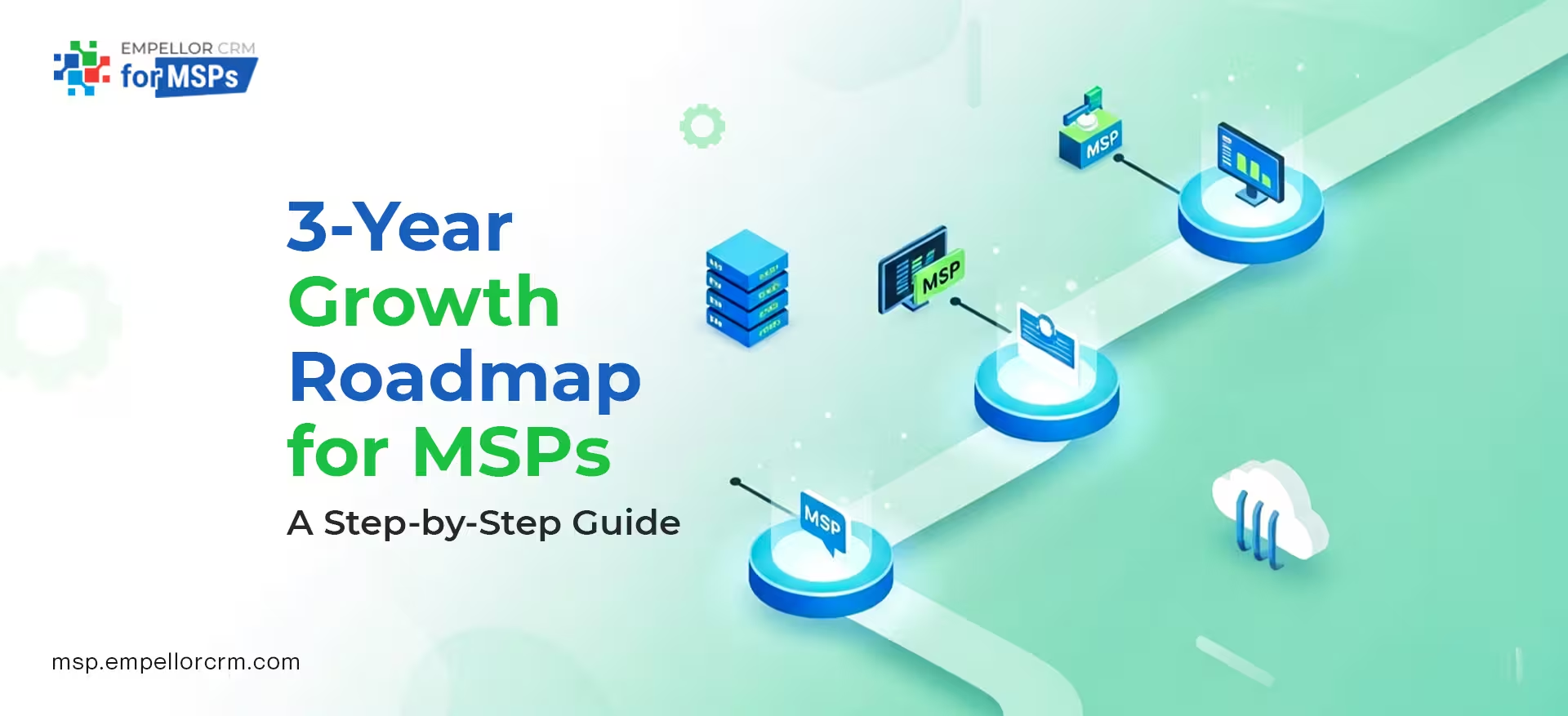
A 3-year roadmap changes that. It helps you define where you’re going, what systems will get you there, and how to measure success along the way.
In this guide, you’ll learn how to:
- Set realistic goals that drive revenue
- Build a scalable sales and service process
- Forecast growth using data instead of guesswork
- Use automation and AI to create efficiency
By the end, you’ll have a clear plan to turn your MSP into a revenue engine that grows year after year.
Why Most MSPs Struggle Without a Roadmap
“Hope is not a strategy.” Yet that’s how many MSPs operate. They grow when a few big clients renew, shrink when projects dry up, and repeat the same cycle each year.
Without a roadmap, it’s easy to confuse activity with progress. The team stays busy, but there’s no clear direction or measurable goal beyond “get more clients.”
Common traps include:
- Relying too heavily on referrals
- Missing renewals due to manual reminders
- Having no standardized sales or follow-up process
These habits keep MSPs reactive instead of proactive. Growth stalls because decisions are made week to week, not with a three-year vision in mind.
Empellor CRM’s MSP research found that most MSPs lose growth potential not from competition but from a lack of structured planning beyond 12 months.
A roadmap changes the mindset. It forces you to plan for predictable revenue, define priorities, and align every department with measurable outcomes.
Once you stop winging it, you stop guessing and start growing.
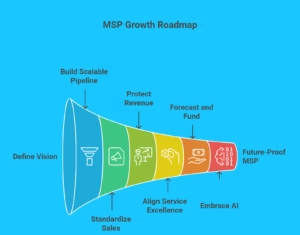
Step 1 — Define Your Vision and Growth Targets
The first step to scaling your MSP is knowing exactly where you’re going. Without a clear vision, every goal feels random, and your team can’t rally around a shared direction.
Start by setting real revenue and margin goals for the next three years. Avoid “feel-good” targets that look ambitious but aren’t based on data. Use your current MRR, churn rate, and client mix to set goals that stretch your business without breaking it.
Next, define your differentiation strategy. Ask yourself:
- What kind of clients deliver the most predictable, profitable work?
- What outcomes do we help them achieve that others don’t?
- Why should they choose us instead of another MSP?
Empellor CRM’s research shows that MSPs with a clear niche grow twice as fast as generalists. Specializing builds authority and lets you compete on value, not price.
To make this step real, use tools like Empellor’s Growth Assessment and KPI dashboards. They help you visualize your current position and set measurable 3-year goals for MRR, margin, and client expansion.
Deliverable: A written 3-year growth vision with specific targets for revenue, margin, and client type.
Step 2 — Build a Scalable Pipeline
Referrals are great, but they can’t be your only growth engine. They come in waves, not systems, which makes your pipeline unpredictable. A scalable MSP needs consistent lead flow that doesn’t depend on word of mouth.
Start by layering in demand generation and lead nurturing. Combine educational content, email campaigns, and industry events to attract prospects before they’re ready to buy. Then, use your CRM to manage the entire journey — from first touch to closed deal.
Your CRM should handle:
- Lead scoring so your sales team focuses on high-potential accounts
- Segmentation by industry, size, or lifecycle stage
- Automated follow-ups that keep conversations warm
Empellor CRM’s research found that MSPs with structured pipeline processes grow 30% faster than those that rely on referrals alone.
Set quarterly pipeline targets that tie directly to your revenue goals. For example, if you want $1 million in new MRR over three years, plan how many qualified leads you’ll need each quarter to stay on track.
Deliverable: A documented demand generation plan and quarterly pipeline growth targets tracked inside your CRM.
Step 3 — Standardize Your Sales Process
Many MSPs lose deals not because of competition, but because their sales process isn’t consistent. When each rep handles discovery, quoting, and follow-ups differently, leads slip through the cracks and margins shrink.
The solution is to create a repeatable sales playbook that outlines exactly how your team sells. It should include:
- Ideal Customer Profiles (ICPs)
- Discovery and qualification questions
- Objection handling and pricing guidelines
- Templates for proposals and renewal conversations
Once your playbook is defined, automate the workflow. Use tools like Experlogix CPQ to standardize quoting and proposal generation. This reduces human error, speeds up approvals, and keeps every deal profitable.
Your CRM should also run automated reminders for follow-ups and stage updates. Forecasting dashboards inside Dynamics 365 help you see what’s in the pipeline, what’s stuck, and what’s about to close.
Empellor CRM’s data shows that MSPs who standardize their sales process shorten their sales cycle by 20 to 30 percent within the first year.
Deliverable: A documented sales playbook and CRM-based workflow that reduces your sales cycle and improves consistency.
Step 4 — Protect and Expand Existing Revenue
New clients grow your top line, but renewals and upsells protect your foundation. Many MSPs focus on new sales while quietly losing revenue through churn, missed renewals, and neglected expansion opportunities.
Start by automating renewal tracking and billing with Work 365. Every contract should have clear renewal dates, alerts, and automated workflows to prevent missed opportunities.
Next, build a client health scoring system to track engagement, ticket volume, and satisfaction. This allows your account managers to spot issues early and turn check-ins into growth conversations. Schedule regular Quarterly Business Reviews (QBRs) that focus on client outcomes and strategic improvements, not just ticket counts.
Empellor CRM’s MSP research found that a five percent reduction in churn can lift profits by more than twenty percent. Protecting existing revenue is the most efficient path to growth.
Finally, design an upsell and cross-sell roadmap that introduces new services such as cybersecurity, compliance, or cloud voice. Each client conversation should include a next-step opportunity.
Deliverable: Churn below five percent and a client expansion plan that grows wallet share year over year.
Step 5 — Align Service Excellence with Revenue
Your service team is more than a support function. It’s your hidden sales engine. Every ticket, project, and client interaction is a chance to prove value, strengthen relationships, and uncover growth opportunities.
When service performance connects to revenue outcomes, your entire MSP becomes growth-focused. Start by setting KPIs that link service quality to account health, such as:
- Ticket resolution time vs. client satisfaction
- Net Promoter Score (NPS) trends by account
- Retention and upsell rates linked to service response
Next, empower your service team with tools that make their impact visible. Platforms like Dynamics 365 Customer Service and Work 365 allow clients to access self-service portals, view open tickets, and monitor renewals. Transparency builds trust, and trust builds retention.
Empellor CRM’s research shows that MSPs that align service KPIs with revenue metrics increase client retention by up to 18 percent within two years.
Deliverable: A service-to-revenue framework in year two that connects support quality to measurable account growth.
Step 6 — Forecast and Fund Growth Intelligently
Guessing is not forecasting. Many MSPs rely on spreadsheets and gut instinct to plan revenue or staffing, but that approach breaks down fast as you scale.
Start by tracking the key MSP performance metrics that reveal true business health:
- Monthly Recurring Revenue (MRR)
- Churn rate
- Customer Acquisition Cost (CAC)
- Lifetime Value (LTV)
- Pipeline velocity and win rate
Integrate your CRM, PSA, and accounting data into Power BI dashboards so you can monitor these metrics in real time. This lets you spot revenue leaks early and make confident decisions about hiring, marketing, and investments.
Use scenario planning inside Dynamics 365 and Power BI to model what happens if you increase retention, add a salesperson, or launch a new service. This gives you a rolling 12- to 24-month forecast that shows the impact of every move before you make it.
Empellor CRM’s data shows that MSPs using integrated forecasting tools outperform peers by 35 percent in revenue predictability.
Deliverable: A live, data-driven forecast dashboard that helps you plan revenue and resources up to two years ahead.
Step 7 — Embrace AI and Future-Proof Your MSP
The MSP market is changing fast. Clients expect proactive insights, not just support. AI is how modern MSPs deliver that.
Start by introducing Microsoft Copilot into your daily operations. Use it to handle CRM data entry, summarize client emails, and surface key trends in your pipeline. Instead of spending hours on reports, your team gets instant visibility into what matters most.
Next, apply AI-driven insights to your client base. Predict which accounts are likely to churn based on service history or sentiment data. Identify upsell opportunities from usage trends or open tickets. AI turns raw data into action, giving you a competitive edge without adding complexity.
Empellor CRM’s research found that MSPs using AI for forecasting and client analysis grow 1.5 times faster than those who don’t.
Finally, prepare your MSP to evolve into what the industry calls a Managed Intelligence Provider (MIP). That means moving from simply managing infrastructure to managing intelligence — guiding clients through decisions with real-time data and predictive insights.
Deliverable: An AI readiness framework by year three that supports forecasting, automation, and client analytics across your MSP.
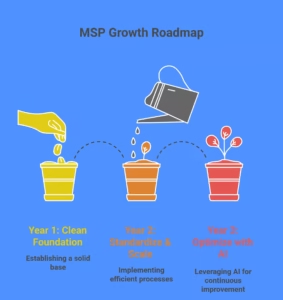
Example 3-Year MSP Growth Roadmap (Template)
Every MSP’s journey looks different, but the most successful ones share a simple structure — quick wins first, then scalable systems, then optimization through data and AI.
Here’s what a practical 3-year roadmap looks like when executed with focus and discipline:
Year 1: Clean the Foundation
Goal: Build visibility, consistency, and quick revenue wins.
- Audit your pipeline and migrate data into a centralized CRM.
- Automate renewals and billing using Work 365.
- Define your niche and refine your messaging.
- Establish KPI dashboards for MRR, churn, and pipeline value.
Outcome: Predictable revenue flow and reduced churn.
Year 2: Standardize and Scale
Goal: Turn individual wins into repeatable systems.
- Implement a sales playbook and automate quoting with Experlogix CPQ.
- Connect service metrics to revenue KPIs using Dynamics 365 Customer Service.
- Introduce regular client QBRs and health scoring.
- Train your team on CRM adoption and change management.
Outcome: A self-sustaining sales and service engine that scales without chaos.
Year 3: Optimize and Evolve with AI
Goal: Move from reactive management to intelligent forecasting.
- Integrate Power BI dashboards for scenario planning and forecasting.
- Deploy Microsoft Copilot for CRM and data analysis.
- Implement AI-driven churn prediction and upsell automation.
- Finalize your transition toward a Managed Intelligence Provider model.
Outcome: Data-driven decision-making and long-term profitability.
Deliverable: A 3-year roadmap document with yearly priorities, measurable KPIs, and system milestones.
Don’t Wing It — Build Your Growth Engine
Most MSPs don’t fail because they lack talent or clients. They fail because they never commit to a clear, structured plan. Growth without direction leads to burnout, chaos, and missed opportunity.
A 3-year roadmap gives you focus. It connects vision to execution and helps you see progress month by month. When your CRM, quoting, billing, and reporting systems all support the same goals, growth becomes repeatable instead of random.
Empellor CRM helps MSPs turn plans into action. Through the MSP Revenue Flywheel Framework, we guide you from strategy to measurable outcomes using Dynamics 365, Experlogix CPQ, Work 365, and Power BI.
Stop guessing where your next stage of growth will come from. Start building a system that makes it happen.
Book your MSP Growth Assessment today and map out a 3-year plan built for predictable, sustainable growth.
FAQs: MSP Growth Planning Questions Answered
Q1: What’s the difference between a roadmap and a business plan?
A business plan outlines what your company does. A roadmap shows how you’ll grow it.
It turns ideas into steps, sets timelines, and assigns accountability. For MSPs, a roadmap connects your goals with daily execution inside your CRM, service, and finance systems.
Q2: How detailed should a 3-year MSP roadmap be?
Keep it practical. You don’t need a 100-page report. Your roadmap should fit on one page with clear yearly goals, KPIs, and ownership.
The key is to make it measurable and visible to everyone on your team.
Q3: Which KPIs should MSPs track to measure progress?
Track the numbers that show real growth:
- Monthly Recurring Revenue (MRR)
- Churn rate
- Lead-to-close conversion rate
- Customer Acquisition Cost (CAC)
- Lifetime Value (LTV)
- Ticket-to-revenue ratio
Empellor CRM’s data shows MSPs that monitor these KPIs monthly are twice as likely to hit their growth targets.
Q4: How often should the roadmap be updated?
Review it every quarter and make adjustments once a year.
Markets, tools, and client expectations shift fast, so your roadmap should stay flexible. Use Power BI dashboards to track your progress and adjust goals based on performance trends.